Digital Church

The Feed Is Not Random: Why the Algorithm Matters More Than Parents Realize

Most parents understand that social media influences their children.

What many do not realize is how personal that influence has become.

When your child opens YouTube, TikTok, Instagram, Snapchat, or another platform, they are not simply seeing the same content as everyone else. They are seeing content selected specifically for them.

The feed is not random.

Algorithms track behaviour. They notice what users watch, pause on, click, like, replay, and share. Over time, they learn what captures attention, and then they serve more of the same.
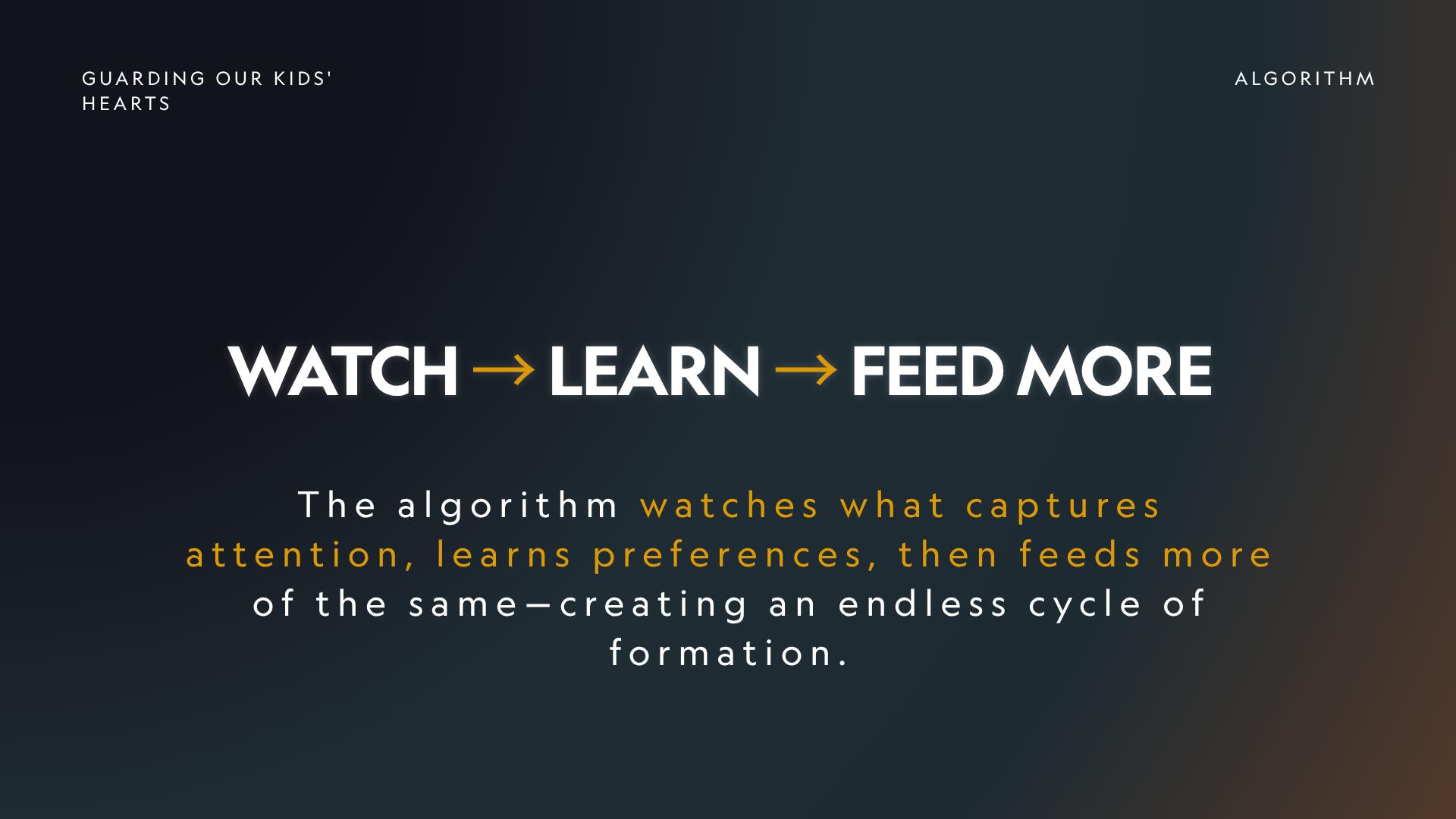
Watch. Learn. Feed more.

That cycle is powerful because it does not simply entertain. It forms.

If a young person watches content built around comparison, they will likely see more comparison. If they engage with relationship drama, they will likely see more relationship drama. If they pause on toxic dating advice, hypersexualized content, or identity-shaping messages, the platform learns.

The algorithm does not ask, “Is this good for them?”

It asks, “Will this keep them watching?”

That matters because time shapes taste.

SQ Magazine reports that Gen Z spends roughly 2 hours 55 minutes to 5 hours per day on social media, and only 3% spend less than 1 hour a day. For Gen Alpha, kids ages 0–8 are already averaging around 2.5 hours of daily screen time.

This is not about one bad video.

It is about thousands of small moments forming what feels normal.

Romans 12:2 says:

“Do not conform to the pattern of this world, but be transformed by the renewing of your mind.”

Paul’s words remind us that formation happens through patterns. Repeated exposure shapes the mind. What shapes the mind eventually shapes the life.

That is why digital discipleship matters.

Parents do not need to panic. But we do need to pay attention.

Instead of only asking, “What apps are my kids using?” we can ask:

  • What ideas are they encountering repeatedly?

  • What view of love are they absorbing?

  • What kind of person is this content teaching them to become?

  • Who is teaching first?

Because who teaches first often teaches most.

If the algorithm is discipling our children through repetition, then our response cannot be silence. It must be presence, wisdom, and conversation.
The goal is not control.

The goal is discernment.

Start Here

Accepting Christ as your Savior is always a moment for celebration, but when we see our kids wanting to make this decision, it’s a wonderful thing! However, it is something that usually happens away from mom and dad (in Sunday school or during summer camp) and it is our goal to not only have the conversation with the parents, but to help them to make it a family celebration. We don’t want them to miss out. There are so many family discussions and moments that can take place during this “process of discovery” for a child. To also note, there are some circumstances whereby the child might not be celebrated at home for their decision and, in those instances, our goal is that the child's small group leader will walk with them as they process what having a Saviour means to them. 

One parent described the process of discussing the decision of accepting Christ as Savior:

Sometimes I get stuck in my own head as I talked with my kids about accepting Christ. It is such an important decision that I want them to make for themselves. When my kids asks my about Jesus and how to accept Him as their Saviour and I am caught off guard, or distracted I get flustered and begin to over-spiritualize the conversation to a point that my kids do not understand. I start using church language instead of having an age appropriate and child-friendly conversation.

How do I make sure that my child understands the importance of this decision and at the same time talk to them in a way they understand?

Another parent asked us:

How often should I talk to my kids about accepting Christ? I see that they are asking good questions, but I do not want them to feel like I am pressuring them, or have them start to ignore me because I have asked them too often.

I love the simplicity and clarity of the “Start Here” program as it guides parents through this process. The “Start Here” program is a tangible, simple brochure that helps the parent walk with the child in their decision, and it’s all centered around a verse that many of us know and teach our kids.

We even have parents who wonder if they ask too much about their child’s walk – or lack thereof – with Christ. Our curriculum 252 Basics uses an easy to read and understand version of this message, and this is the basis of the “Start Here” program: 

God so loved the world that he gave his one and only Son. Anyone who believes in him will not die but will have eternal life.
— John 3:16 NIrV

The parent literature that comes with “Start Here” is fully customizable and editable, and is a wonderful starting point for your ministry to equip parents. It also addresses a family Q&A to guide and direct the conversation towards the end goal. Our leaders will soon be equipped with this material to ensure that conversations happening in our small-group time, that the messaging is consistent, and that the parental until is provided with easy follow-up. 

In the end, how well parents, volunteers and leaders are equipped to have important conversations is essential in how the Gospel message is clearly shared. “Start Here” covers all of these and we can’t wait to see how our ministry and families benefit from the conversations that are encouraged through it.