Most parents understand that social media influences their children.
What many do not realize is how personal that influence has become.
When your child opens YouTube, TikTok, Instagram, Snapchat, or another platform, they are not simply seeing the same content as everyone else. They are seeing content selected specifically for them.
The feed is not random.
Algorithms track behaviour. They notice what users watch, pause on, click, like, replay, and share. Over time, they learn what captures attention, and then they serve more of the same.
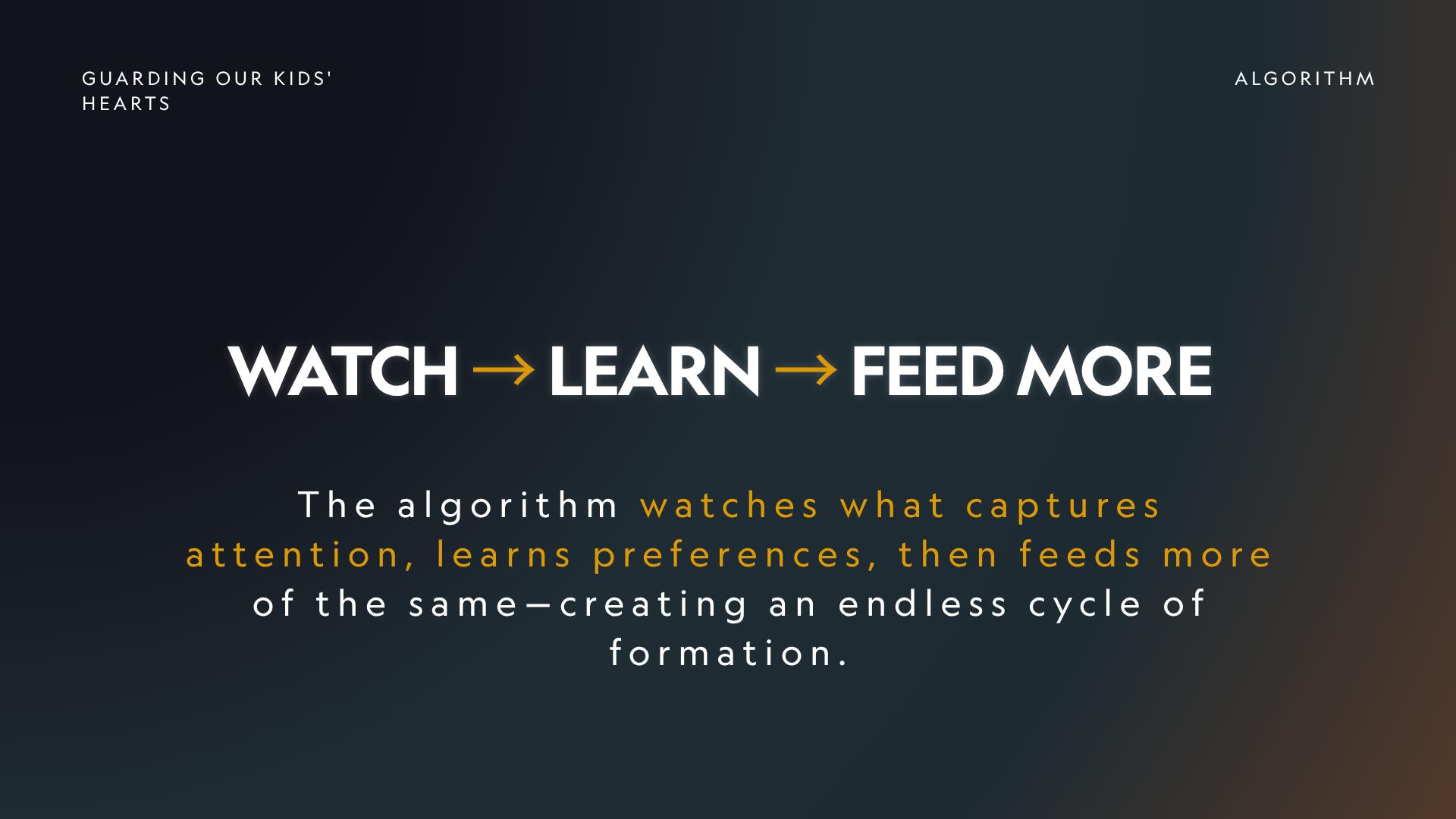
Watch. Learn. Feed more.
That cycle is powerful because it does not simply entertain. It forms.
If a young person watches content built around comparison, they will likely see more comparison. If they engage with relationship drama, they will likely see more relationship drama. If they pause on toxic dating advice, hypersexualized content, or identity-shaping messages, the platform learns.
The algorithm does not ask, “Is this good for them?”
It asks, “Will this keep them watching?”
That matters because time shapes taste.
SQ Magazine reports that Gen Z spends roughly 2 hours 55 minutes to 5 hours per day on social media, and only 3% spend less than 1 hour a day. For Gen Alpha, kids ages 0–8 are already averaging around 2.5 hours of daily screen time.
This is not about one bad video.
It is about thousands of small moments forming what feels normal.
Romans 12:2 says:
“Do not conform to the pattern of this world, but be transformed by the renewing of your mind.”
Paul’s words remind us that formation happens through patterns. Repeated exposure shapes the mind. What shapes the mind eventually shapes the life.
That is why digital discipleship matters.
Parents do not need to panic. But we do need to pay attention.
Instead of only asking, “What apps are my kids using?” we can ask:
What ideas are they encountering repeatedly?
What view of love are they absorbing?
What kind of person is this content teaching them to become?
Who is teaching first?
Because who teaches first often teaches most.
If the algorithm is discipling our children through repetition, then our response cannot be silence. It must be presence, wisdom, and conversation.